
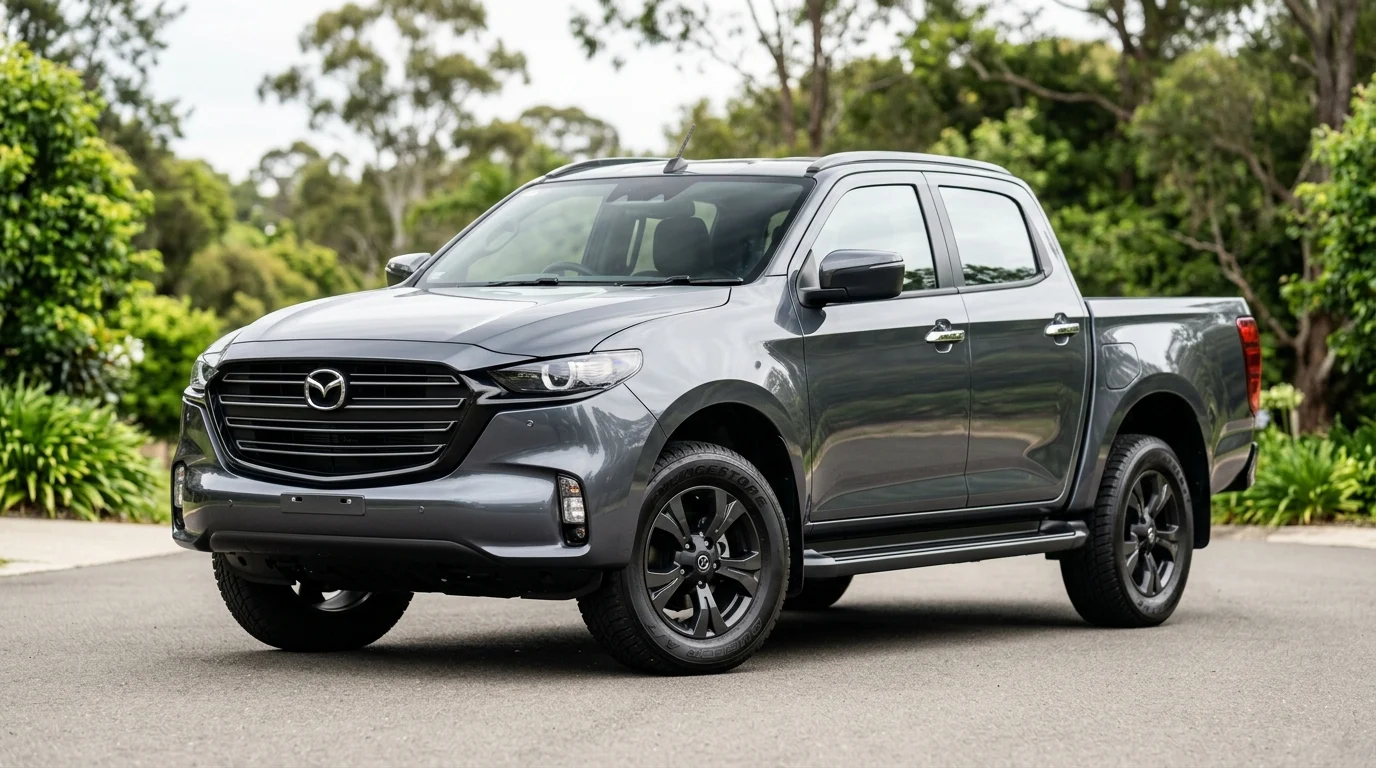
The Mazda BT-50 is built to work, but its towing confidence depends on more than engine torque and a strong hitch. With a braked towing capacity of up to 3,500 kg, the 2020-on BT-50 can haul large caravans, boat trailers, and commercial loads—yet standard mirrors are often too narrow to see past bulky trailers. That gap in visibility can affect lane changes, highway merging, reversing, and legal compliance. This article explains where factory mirrors fall short, how purpose-built BT-50 towing mirrors improve rearward vision, and what design features matter most when you want a safer, more stable towing setup.
Why BT-50 Owners Need Purpose-Built Towing Mirrors
The modern Mazda BT-50 (particularly 2020 and newer generations) boasts a 3,500 kg braked towing capacity, making it a capable choice for hauling large caravans, heavy boat trailers, and commercial loads across demanding terrains. However, maximizing this towing potential requires more than just a heavy-duty hitch and an integrated brake controller.
Factory stock mirrors equipped on the Mazda BT-50 are designed primarily for basic daily observation and standard commuter driving. When paired with a large, bulky trailer, these standard mirrors cannot cover the full rear and trailer views, creating blind spots and increasing road risks for all motorists.
Where Factory Mirrors Fall Short
Factory mirrors are dimensionally optimized for the BT-50’s standard overall body width of approximately 1,870 mm. When hauling a full-size caravan or an enclosed utility trailer—which frequently measures up to 2.4 meters wide—the standard mirrors simply cannot see past the trailer’s front edges.
This physical limitation creates a significant blind spot directly behind the towed load. Consequently, drivers lose critical visibility of overtaking vehicles and fast-approaching highway traffic, making highway merging, lane changes, and tight maneuvers challenging. It is also important to note that towing mirror requirements are governed by specific regulations, such as the Australian Design Rules (ADRs) or state-based towing codes in the BT-50’s core markets. In these regions, maintaining a clear field of vision extending past the towed load is a strict legal requirement, making standard mirrors legally and practically insufficient for heavy-duty hauling.
How Towing Mirrors Improve Rear Visibility
Purpose-built BT-50 towing mirrors adopt a customized structural design engineered to push the reflective surface outward, effectively extending beyond the trailer’s sides. By extending the mirror housing an additional 100 mm to 200 mm away from the vehicle door, these mirrors restore a clear, uninterrupted line of sight down both flanks of the towed load.
Furthermore, most dedicated towing configurations feature a dual-glass setup. This includes a large, flat upper mirror glass for true distance perception and a smaller, independently adjustable convex lower mirror. They expand viewing angles for towing work, capturing adjacent lanes, low obstacles, and rear trailer corners that single-glass factory mirrors completely miss. However, drivers must remember a critical safety caveat: convex glass inherently distorts distance perception, making objects appear smaller and farther away than they actually are.
How BT-50 Towing Mirrors Compare With Factory Mirrors
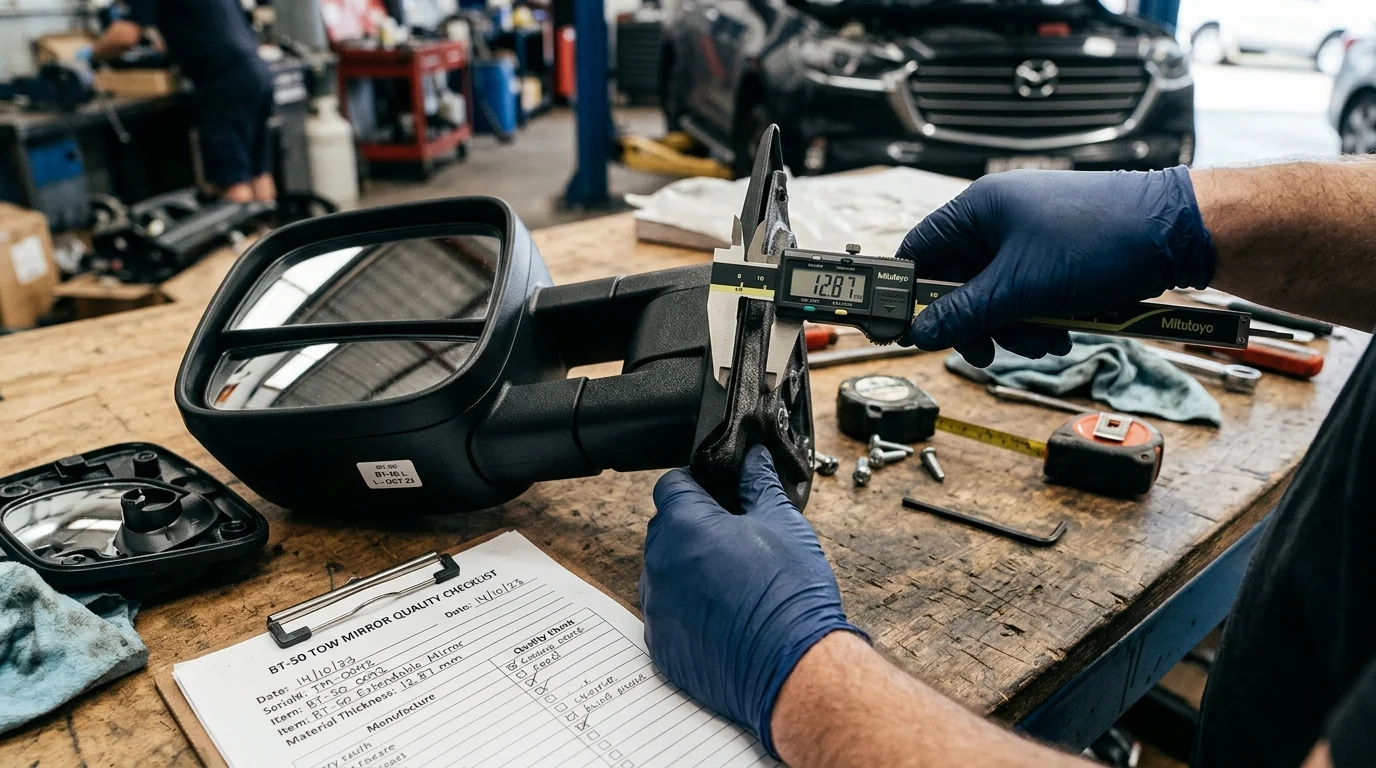
Evaluating the operational differences between standard stock components and specialized towing upgrades reveals different design priorities. While factory mirrors prioritize aerodynamics and compact parking, purpose-built towing mirrors focus on vision expansion and structural rigidity under heavy dynamic loads.
Key Design and Fitment Differences
Purpose-built towing mirrors are calibrated for the Mazda BT-50 body structure, ensuring stable mounting directly into the OEM door fixtures without requiring aftermarket drilling. It is important to distinguish between temporary clip-on extenders—which attach to stock mirrors and are viable for occasional use—and full replacement towing mirrors. While clip-ons are cost-effective, they can scratch or damage factory mirror housings over time due to vibration, a key factor for owners weighing temporary versus permanent solutions.
While premium full replacements utilize the factory wiring harness to maintain features like power glass adjustment and integrated LED indicators, buyers must be cautious. The retention of OEM features—such as blind-spot monitoring (BSM), heated glass, and 360-degree cameras—depends heavily on the vehicle’s specific trim level and the aftermarket brand chosen. Many replacement mirrors lose BSM functionality entirely or require dealer-level calibration to work correctly.
| Feature | Factory BT-50 Mirrors | Purpose-Built Towing Mirrors |
|---|---|---|
| Lateral Extension | Fixed (0 mm extra reach) | Telescopic (100 mm to 200 mm extra) |
| Glass Configuration | Single flat or slight convex | Dual-glass (Flat upper, convex lower) |
| Mounting Hardware | Standard OEM construction | Reinforced housing engineered for extended dynamic loads |
| Vibration Tolerance | Inherently stable for standard driving | Requires reinforced design to counter aerodynamic stress |
Trade-Offs in Visibility, Stability, and Convenience
The primary trade-off when upgrading involves balancing expanded visibility against daily driving convenience. Extended mirrors inherently face greater aerodynamic drag, which introduces a potential fuel-economy penalty, increased wind noise, and greater leverage and stress on the door mounts. To counteract this, premium towing mirrors incorporate heavy-duty internal steel brackets that maintain stable vision while driving, ensuring a vibration-free image even at sustained highway speeds.
The increased physical width also significantly impacts garage access and narrow-track off-roading. Beyond garage and trail clearance issues, this extra width poses a strike risk to pedestrians, cyclists, and adjacent vehicles in narrow urban lanes. While many modern replacement models include manual or power-folding mechanisms to help the vehicle retain a manageable footprint when unhitched, drivers must remain mindful of the added width in tight parking scenarios. Ultimately, this dedicated upgrade optimizes towing safety, provided the driver accounts for the larger dimensions and aerodynamic trade-offs.
Safety, Installation, and Maintenance Tips
Upgrading to dedicated towing mirrors fundamentally changes the driving experience of the BT-50, enhancing the safety and compliance of an already capable towing platform. However, maximizing the safety benefits of these mirrors requires proper driving techniques, precise initial installation, and consistent ongoing maintenance.
Safer Lane Changes, Reversing, and Highway Towing
The expanded viewing angles provided by the convex lower glass significantly reduce adjacent blind spots, making lane changes, highway merging, and long-distance towing considerably safer. Drivers gain a wider field of view, which is critical for monitoring trailer sway and maintaining precise positioning. When reversing a heavy caravan into a narrow driveway, the dual-glass setup allows the driver to simultaneously monitor the trailer’s roofline clearance and the ground-level tire trajectory.
Despite these substantial optical enhancements, towing mirrors do not entirely eliminate the need for traditional defensive driving practices. Drivers should always perform manual shoulder checks before lane changes or reversing to visually confirm the space is clear and ensure maximum safety.
Installation Checks and Ongoing Care
Because specialized mirrors are heavier and
Key Takeaways
- Use towing mirrors when your caravan or trailer is wider than the BT-50, because factory mirrors are designed around the ute’s approximate 1,870 mm body width.
- Match mirror choice to the BT-50’s towing capability, as a 3,500 kg braked rating still requires clear rear visibility for safe lane changes and merging.
- Choose purpose-built mirrors that extend roughly 100 mm to 200 mm outward to improve sightlines down both sides of a wide trailer.
- Look for a dual-glass design with a flat main mirror for distance judgment and a convex lower mirror for wider blind-spot coverage.
- Treat convex mirror views carefully, because vehicles and obstacles may appear smaller and farther away than they really are.
- Select model-specific 2020-on BT-50 towing mirrors that use OEM mounting points rather than requiring aftermarket drilling.
Frequently Asked Questions
Do Mazda BT-50 owners need towing mirrors for caravans?
Yes, if the caravan or trailer is wider than the ute and blocks rearward vision. The BT-50 can tow up to 3,500 kg braked, but safe towing still depends on seeing clearly past both sides of the load.
Why are factory BT-50 mirrors not enough for heavy towing?
Factory mirrors suit the BT-50’s approximate 1,870 mm body width. A full-size caravan or enclosed trailer can be around 2.4 m wide, which can hide overtaking traffic and create blind spots behind the trailer.
How much extra visibility do purpose-built towing mirrors provide?
Dedicated BT-50 towing mirrors typically extend the mirror position outward by about 100 mm to 200 mm, helping restore a clearer line of sight along both sides of a wide trailer.
What is the benefit of dual-glass towing mirrors?
A dual-glass design usually combines a flat upper mirror for accurate distance judgment with a convex lower mirror for wider coverage of adjacent lanes, low obstacles, and trailer corners.
Are clip-on towing mirrors as good as full replacement mirrors?
Clip-on mirrors can work for occasional towing, but full replacement towing mirrors are generally more stable, better integrated, and better suited to frequent highway towing or heavy loads.