
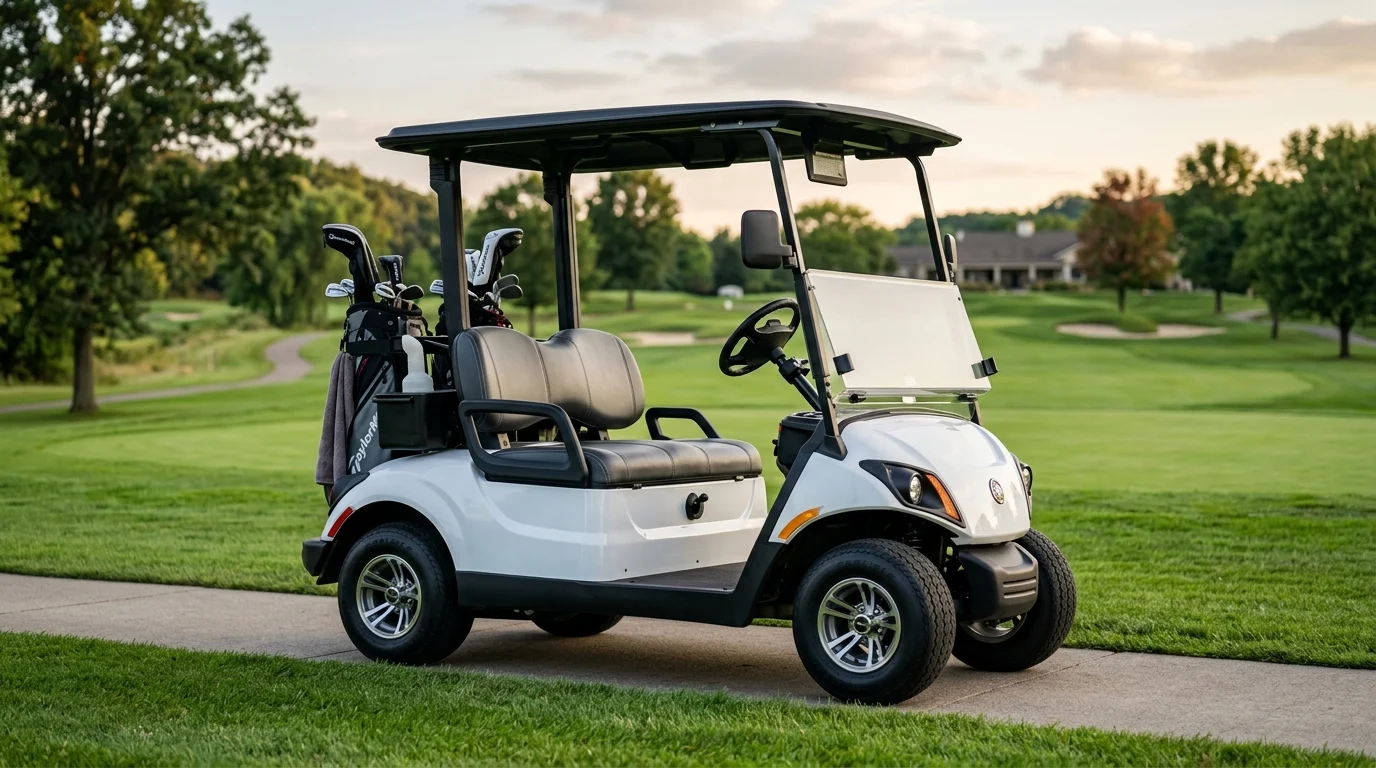
Why Choose a Commercial 2-Seater Electric Golf Cart UEV
A commercial 2-seater electric golfcart Utility Electric Vehicle (UEV) combines heavy-duty performance with semi-automatic convenience. Powered by a high-efficiency 72V lithium battery, these vehicles deliver superior hill-climbing power, faster acceleration, and a reliable range of 60 to 90 kilometers per charge. Operating an electric fleet is incredibly cost-effective; it costs just $0.50 to $1.00 for a full charge, making it 70% to 80% cheaper to run than traditional gas alternatives. Furthermore, the semi-automatic transmission eliminates manual gear shifting, significantly reducing driver fatigue for staff during long shifts.
Market Demand for Electric Golf Carts
The global push for operational efficiency and zero-emission transit is driving massive growth in the electric golfcart sector. Industry projections indicate the electric golf cart market is expanding at a 6% to 8% compound annual growth rate (CAGR), on track to reach an estimated $4.1 billion by 2032. Commercial fleet managers are rapidly adopting modern power solutions, with lithium batteries now hitting an 82% market penetration rate. Lithium technology provides three times the energy density of traditional lead-acid alternatives and boasts an impressive lifespan of 8 to 10 years with zero watering or maintenance required.
Best Use Cases for Commercial Fleets
While standard models often stay on the fairways, a commercial UEV is engineered for multi-use versatility. The compact 2-seater design is exceptionally maneuverable, making it ideal for navigating tight paths, crowded walkways, and solo staff assignments.
Top commercial applications include:
- Golf Courses & Country Clubs: Vehicles can be outfitted with optional golf accessories, including bag holders, scorecard mounts, ball washers, sand bottles, and custom coolers.
- Resorts & Gated Communities: The quiet, zero-emission electric motor provides peaceful, unobtrusive transport for guest shuttles, housekeeping, and security patrols.
- Industrial & Campus Logistics: Built with a reinforced chassis, durable body panels, and CE certification, these UEVs easily handle daily heavy commercial use across university campuses, warehouse facilities, theme parks, and airports.
By prioritizing a 72V lithium setup and a commercial-grade build, facilities benefit from a lower total cost of ownership while maximizing daily fleet reliability.
Key Features for Daily Commercial Use
 When a vehicle is expected to run continuously, consumer-grade features are often insufficient. Unlike basic recreational carts, commercial UEVs feature a reinforced chassis, higher payload capacity, and all-weather durable body panels. Safety and compliance are also paramount; commercial models should be equipped with reliable hydraulic brakes, seat belts, and full lighting packages (headlights, taillights, and turn signals).
While many models carry CE certifications, buyers must verify local compliance. These vehicles are typically restricted to private property unless homologated with specific low-speed vehicle (LSV) equipment—such as DOT-approved windshields, tires, mirrors, and reflectors. Crucially, adding DOT or LSV equipment alone does not automatically make the vehicle street-legal in every region or municipality; local jurisdictional approval is always required.
Beyond the exterior build, modern engineering makes these carts both capable and user-friendly for daily operators.
2-Seater Layout and Semi-Automatic Drive
One of the biggest hurdles in managing a commercial fleet is driver training and fatigue. That is where the simplified drive system shines. While often loosely marketed as a “semi-automatic” drive, electric UEVs actually utilize a single-speed direct-drive system. This setup features no clutch or gears to shift; operators simply select forward or reverse and press the pedal to accelerate.
This direct-drive mechanism is straightforward enough for operators of all skill levels to drive safely with minimal training. Paired with the compact 2-seater layout, this intuitive convenience allows drivers to focus entirely on their tasks—whether navigating a busy theme park or inspecting an industrial yard—rather than managing complex vehicle controls.
72V Lithium Battery Performance
A major upgrade for modern commercial carts is the 72V lithium battery system. Rapidly becoming a standard among new commercial fleets, lithium batteries offer significantly higher energy density than traditional lead-acid units. The 72V architecture provides noticeably better acceleration and superior hill-climbing power compared to standard 48V systems.
On a single charge via standard 110V/220V smart chargers, operators might see an estimated range of 60 to 90 kilometers under typical load capacities (often supporting payloads of 300 to 400 kg). Top speeds are generally governed around 25 to 40 km/h depending on local regulations. Lithium batteries can last anywhere from 8 to 10 years with minimal maintenance. While you no longer need to water batteries, proper care—such as storing them within recommended temperature limits (typically -10°C to 45°C) and conducting occasional visual inspections—ensures optimal performance.
Disclaimer: All figures regarding range, speed, payload, grade capacity (e.g., 20% to 30% inclines), lifespan, and operating temperatures are illustrative examples. Actual performance will vary significantly based on the manufacturer, specific vehicle configuration, and environmental factors.
| Feature | 72V Lithium Battery | Standard 48V Lead-Acid |
|---|---|---|
| Expected Lifespan | 8 to 10 years | 3 to 4 years |
| Fast Charge Time | Approx. 4 hours | 8+ hours |
| Routine Maintenance | Minimal (Occasional inspections) | Frequent watering & terminal cleaning |
| Hill Climbing Power | High (72V output) | Moderate (48V output) |
Configuration and Buying Guidance for Fleet Managers
Adding a fleet of electric UEVs to your operation is an investment that requires careful planning. The advantage of these modern 2-seater carts lies in their flexibility; they can be tailored on the assembly line to meet exact daily requirements.
By understanding the available configurations and wholesale dynamics, fleet managers can ensure they only pay for the features their teams actually need.
Customization Options by Use Case
Customization is key to maximizing the utility of a UEV. If the carts are destined for a country club, they can be equipped with optional golf accessories like bag holders, scorecard mounts, ball washers, sand bottles, and custom coolers.
For industrial or campus use, those same mounting points can be swapped for practical utility upgrades like cargo boxes, heavy-duty roof racks, lift kits for rough terrain, and upgraded lighting packages. Fleet managers can also select the ideal battery capacity—typically available in 60Ah, 80Ah, or 100Ah configurations. However, it is important to remember that amp-hour capacity alone does not determine range; voltage, motor and controller efficiency, terrain, and payload all interact to dictate how far the vehicle can travel on a single charge.
Wholesale Purchase Considerations
When it comes time to buy, wholesale purchasing offers serious advantages.
Key Takeaways
- Choose a 2-seater electric UEV for routes where compact size, easy maneuvering, and light-duty transport matter more than passenger capacity.
- Compare total operating costs because electric charging is typically far cheaper than refueling gas-powered maintenance vehicles.
- Verify local LSV or street-legal rules before using a commercial golf cart outside private property.
- Prioritize commercial-grade features such as a reinforced chassis, hydraulic brakes, seat belts, lighting, mirrors, and reflectors for daily fleet use.
- Train operators on the direct-drive system, since most electric UEVs do not require clutch control or gear shifting.
Frequently Asked Questions
What is a 2-seater electric UEV best used for?
It is best suited for maintenance crews, security patrols, resort transport, campus mobility, airport logistics, and light-duty hauling in tight commercial spaces.
Is a commercial electric golf cart cheaper to operate than a gas model?
Yes. Electric carts typically cost much less to recharge than gas carts cost to refuel, helping fleets reduce daily operating expenses over time.
Does semi-automatic mean the cart has gears?
Usually no. Most electric UEVs use a single-speed direct-drive system, so operators select forward or reverse and use the accelerator without shifting gears.
Can this type of golf cart be driven on public roads?
Not automatically. Many carts are limited to private property unless they meet local LSV or street-legal requirements and receive approval from the relevant jurisdiction.
What safety features should a commercial golf cart include?
Look for hydraulic brakes, seat belts, headlights, taillights, turn signals, mirrors, reflectors, and durable body panels suitable for daily commercial use.
Post time: Jul-06-2026