

Why towing mirror compliance matters
Regulatory compliance for a towing mirror extends beyond basic road safety; it serves as a critical shield against legal and financial liability. Operating hauling vehicles with uncertified visibility equipment exposes operators to immediate penalties, with jurisdictional fines typically ranging from $100 to over $500. Furthermore, in the event of a collision, insurance adjusters can void claims if non-compliant mirrors are found to have compromised the driver’s field of vision, thereby exponentially increasing corporate liability.
When factory mirrors are not enough
Standard OEM vehicle mirrors are strictly engineered for the dimensions of the unladen vehicle. Once a trailer is attached, the resulting blind spots immediately neutralize the driver’s standard spatial awareness. Traffic enforcement agencies and state laws mandate the installation of an extended towing mirror the moment a trailer obstructs the factory rearward view. Relying on standard equipment when hauling wide loads violates core visibility mandates—such as the requirement to maintain a clear 200-foot unobstructed rear view—making specialized extensions legally compulsory rather than optional accessories.
Compliant mirrors versus oversized mirrors
A pervasive industry myth suggests that simply installing physically larger mirrors satisfies regulatory mandates. In reality, sheer size never guarantees certification.
- Compliant Towing Mirrors: These units are engineered to pass rigorous performance specifications. They hold official certification marks (such as DOT or EU E-marks), guarantee precise lateral fields of view, and feature shatter-resistant glass. Crucially, they pass standardized vibration tests, ensuring the reflection remains distortion-free at highway speeds.
- Oversized Uncertified Mirrors: While these may temporarily expand the visible area, they frequently lack aerodynamic stability and structural integrity, leading to severe visual blurring at high speeds. Because they lack official regulatory approval, utilizing uncertified oversized mirrors carries the exact same legal and financial risks as driving with completely obstructed factory mirrors.
Key towing mirror standards and markings
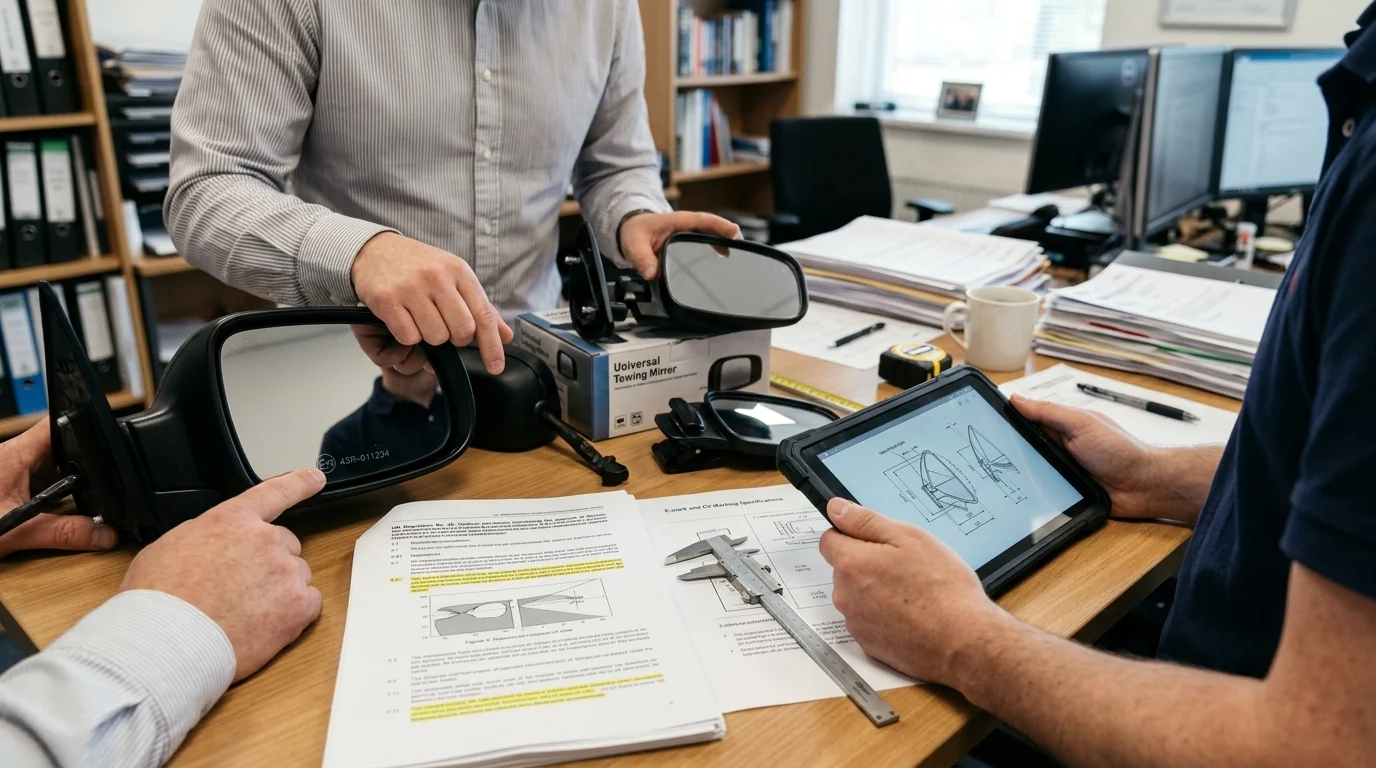
Global transportation authorities have established rigorous performance and optical specifications for towing visibility. These standards dictate not only the required field of view but also the structural integrity of the mirror assembly under high-speed aerodynamic stress.
Manufacturers submit their products to testing protocols to earn the certification marks required for legal road use in specific geographic markets.
FMVSS 111 and ECE R46 field-of-view rules
In the United States, the Federal Motor Vehicle Safety Standard (FMVSS) 111 governs rear visibility. This standard involves specific test procedures based on vehicle classes. While often simplified as an illustration of a 200-foot unobstructed rear view for certain passenger cars and light trucks, exact measurements and targets vary; readers should direct themselves to the official NHTSA/FMVSS text for precise metrics. Conversely, the European Union utilizes the UN ECE R46 standard, which sets specific lateral and rearward field-of-view requirements based strictly on vehicle categories. The Australian Design Rule (ADR) 14/02 draws upon European metrics but is not identical, generally requiring the driver to clearly see a specified width of the road at a set distance behind the vehicle.
| Regulatory Standard | Jurisdiction | Key Visibility Requirement | Compliance Guidance |
|---|---|---|---|
| FMVSS 111 | United States | Specific test procedures (often illustrated as up to a 200-foot rear view for light classes) | Consult NHTSA official regulatory text for exact metrics |
| ECE R46 | European Union | Specific lateral and rearward fields of view (varies strictly by vehicle category) | Refer to UN ECE type-approval checklists |
| ADR 14/02 | Australia | Specified road width visibility at set distances | Check local state transport authority rules |
DOT, E-mark, e-mark, and ADCC certification marks
Proper certification marks serve as proof that a towing mirror has passed required optical and durability tests, including vibration thresholds that prevent image blurring at highway speeds.
- DOT: In the US, a Department of Transportation (DOT) stamp indicates compliance with FMVSS 111 requirements. Crucially, this operates on a manufacturer self-certification basis, not government pre-approval of every individual unit.
- E-mark (Uppercase): Denotes UN ECE type approval for components, meaning the part meets international regulations adopted by the United Nations Economic Commission for Europe. It requires third-party testing. The accompanying number identifies the specific country granting the approval (e.g., E1 for Germany, E4 for the Netherlands, and E11 for the UK).
- e-mark (Lowercase): Signifies European Union (EU) Whole Vehicle Type Approval. Presenting this as a component-level directive approval is misleading; rather, it ties the component to broader vehicle compliance across member states.
- ADCC: In Australia, equipment must meet ADR 14/02 standards. However, ADCC is not a widely recognized standalone mark like DOT or E-mark. Compliance is typically demonstrated via a vehicle compliance plate or through recognized E-mark/e-mark pathways, rather than a distinct “ADCC stamp” on the mirror itself.
While these marks are widely recognized, fleet buyers should verify the exact mark required by their destination country or registration state, as the E-mark (UN ECE) has broader international adoption beyond just the EU. Operating without the regionally appropriate mark can invalidate a vehicle’s compliance status.
How to choose compliant towing mirrors
Selecting the appropriate towing mirror requires balancing payload dimensions, vehicle architecture, and regulatory demands. Buyers must navigate various mounting styles while ensuring the final installation meets all structural and optical criteria.
A thorough evaluation of the hardware helps prevent compliance failures and supports long-term durability in harsh environmental conditions.
Clip-on, strap-on, replacement, and extendable OEM mirrors
The market offers four primary configurations, each with distinct operational trade-offs. Temporary accessory mirrors, such as clip-on and strap-on models, provide a cost-effective solution for occasional haulers. While legally permitted in many areas as temporary add-ons, clip-on mirrors can suffer from aerodynamic vibration, causing image distortion at highway speeds.
Key Takeaways
- Install auxiliary or extended towing mirrors whenever the trailer blocks the factory mirror field of view or creates unsafe blind spots along the trailer sides.
- Do not assume bigger mirrors are compliant; choose units with proper certification markings, optical design, vibration resistance, and secure mounting.
- In the United States, FMVSS 111 governs rear visibility requirements, but exact test criteria depend on vehicle class and should be checked in the official NHTSA text.
- In European and other ECE-aligned markets, ECE R46 sets mirror field-of-view and construction requirements, including rules tied to vehicle category and mirror approval markings.
- Check local width and protrusion limits before using extended mirrors, especially where folding or breakaway mechanisms may be required.
- Using non-compliant towing mirrors can lead to fines, enforcement problems, and insurance disputes if poor visibility contributes to a collision.
Frequently Asked Questions
When do I need towing mirrors?
You need towing mirrors when a trailer blocks or reduces the rearward and side visibility provided by factory mirrors. If you cannot clearly monitor adjacent lanes, trailer sway, or overtaking vehicles, auxiliary or extended mirrors are typically required for safe and compliant towing.
Are larger towing mirrors automatically legal?
No. Legal compliance depends on approved field of view, optical quality, vibration resistance, mounting strength, and required certification markings. Oversized mirrors without proper testing or regional approval may still violate safety rules.
What is FMVSS 111?
FMVSS 111 is the U.S. federal safety standard governing rear visibility for specific vehicle classes. It defines testing and visibility requirements, but exact rules vary by vehicle type, so operators should consult the official NHTSA standard for precise compliance details.
What is ECE R46?
ECE R46 is the European mirror and indirect vision standard. It sets field-of-view, construction, and approval requirements based on vehicle category, and compliant mirrors usually carry recognized approval markings for legal road use in applicable markets.
Can towing mirrors protrude too far from the vehicle?
Yes. Some jurisdictions, including European markets, restrict how far mirrors may extend beyond the vehicle’s maximum width unless they include compliant folding or breakaway features. Always check local width and equipment rules before installation.
Post time: Jul-09-2026