
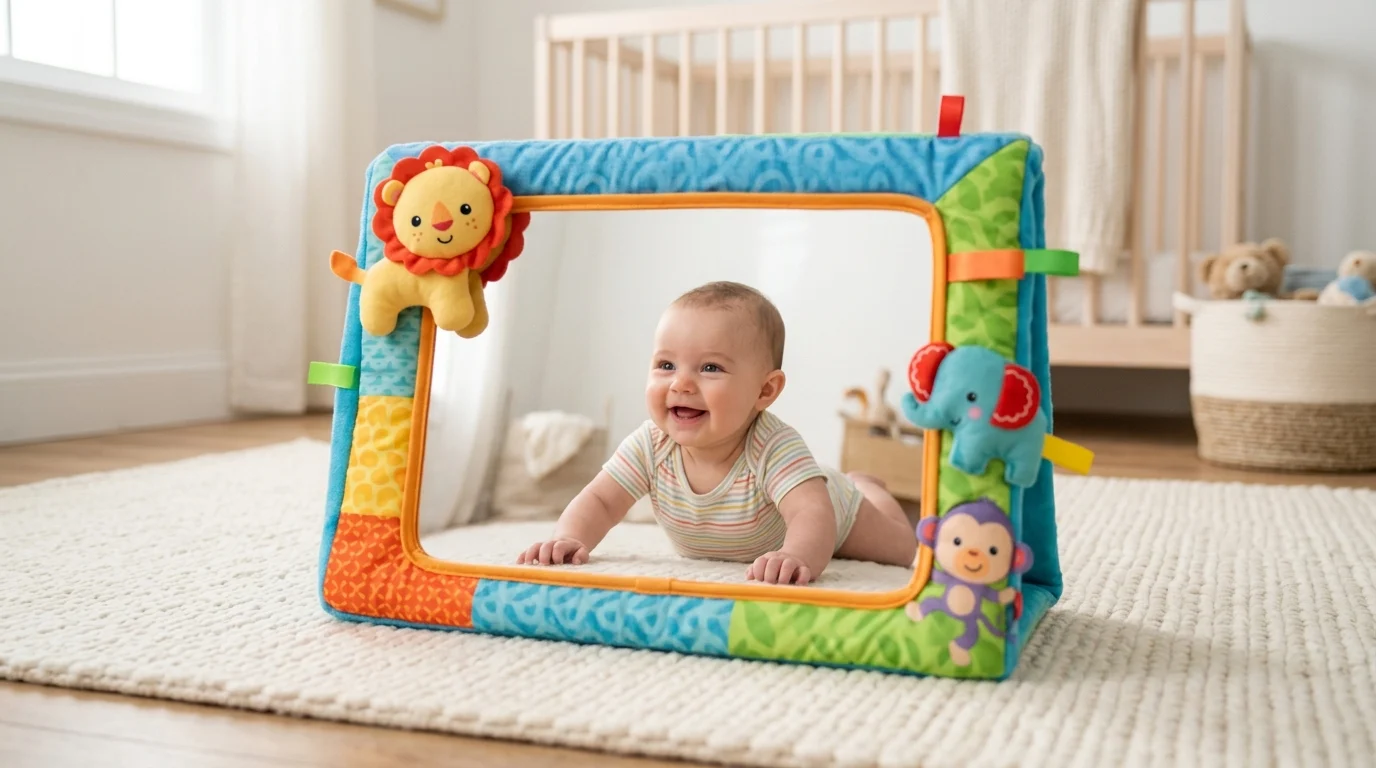
Why Rear-Facing Seats Limit Visibility
When you secure your infant in a rear-facing car seat, you immediately encounter a fundamental visibility problem. Because the NHTSA and AAP recommend keeping children rear-facing until they reach the maximum height or weight limit allowed by the seat manufacturer (typically 40 to 50 pounds and up to 49 inches), you will spend at least the first two to four years of their life driving without a direct line of sight to your child.
Attempting to turn your head to check on a fussy baby forces you to take your eyes off the road, introducing severe driving distractions—studies indicate that taking your eyes off the road for just 2 seconds doubles your crash risk. Furthermore, relying solely on sound is inadequate; without visual confirmation, you face the cognitive distraction of trying to interpret cries and the inability to assess whether a quiet child is breathing safely.
Why Parents Use Baby Mirrors
A clip-on rearview observation mirror solves this challenge efficiently. By mounting a convex reflective surface (typically measuring 7 to 11 inches wide) on the rear seat headrest, it bounces the image of your baby directly into your vehicle’s existing rearview mirror.
Instead of wondering if your child is sleeping, choking, or crying, you gain instant visual confirmation through a simple, ergonomic glance. You can monitor your infant’s status seamlessly while maintaining a forward-facing posture, ensuring you never compromise vehicle control.
How to Avoid Driver Distraction
While this accessory provides critical visibility, you must manage how you interact with it to prevent distraction. The mirror is designed purely for quick, peripheral visual checks instead of continuous watching. Adjust the baby mirror so your child is visible in your existing rearview mirror without requiring you to turn your head or body.
Staring at the reflected image for even 3 seconds at a highway speed of 60 mph means you travel blindly for over 264 feet. To maximize safety, limit your glances to under 1 second and keep your primary attention fixed on the road ahead, traffic signals, surrounding vehicles, and pedestrians. Brief, fast glances are acceptable, but prolonged staring toward reflected images will drastically lower your reaction speed. Remember that this tool never replaces safe driving awareness, proper infant seat installation, or responsible adult supervision.
How Clip-On Baby Mirrors Work
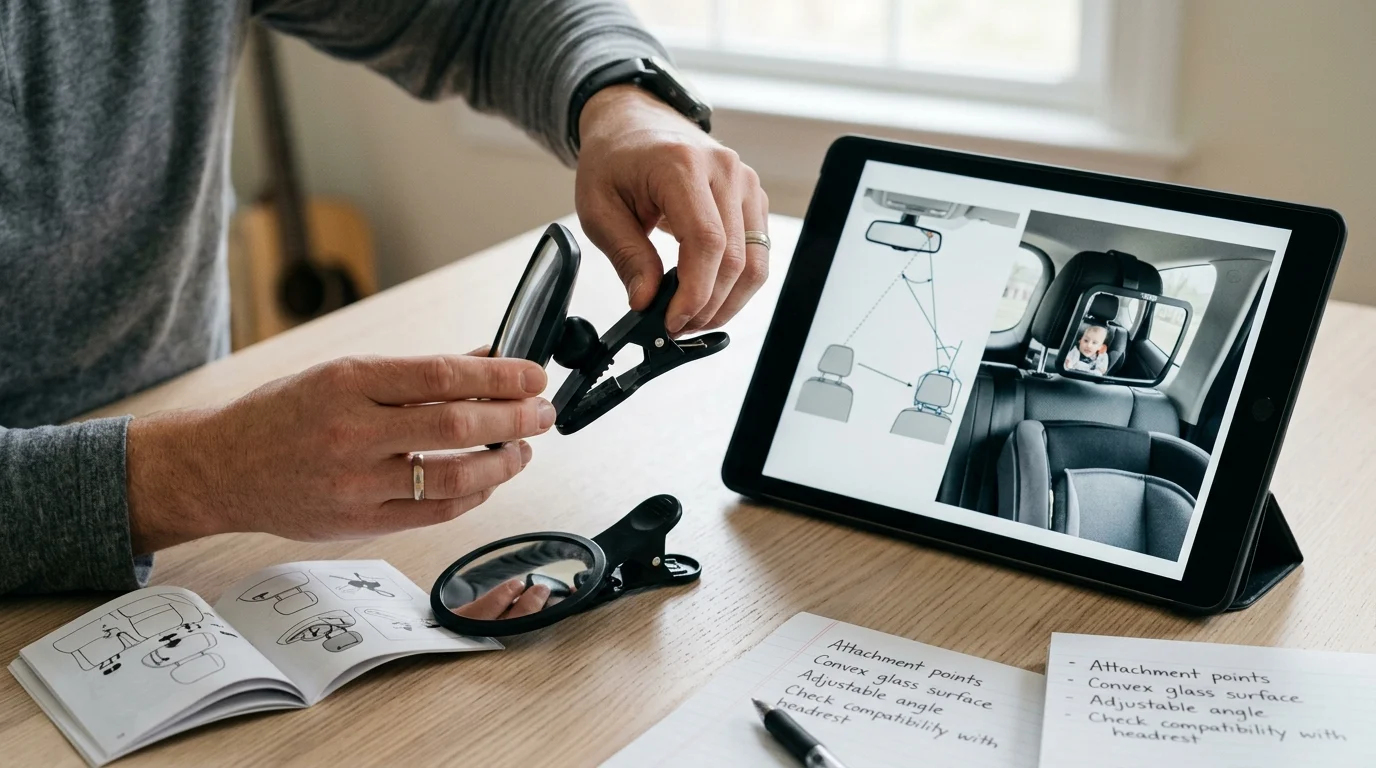
A clip-on baby mirror functions as an extra mirror, utilizing a wide-angle convex lens to capture the entire rear-facing car seat environment. Unlike suction-cup models that frequently detach under extreme cabin temperature fluctuations (which can easily exceed 140°F or 60°C in summer months), clip-on designs utilize mechanical tension to anchor securely onto existing vehicle structures.
This approach provides a stable, vibration-resistant mount capable of withstanding the daily forces of commuting, ensuring your view remains steady rather than a blurry, shaking distraction.
Compatible Headrest Designs
You must evaluate your vehicle’s rear headrest structure before purchasing, as not all car headrest structures suit this clip-on style. These mirrors require an adjustable, independent headrest with exposed metal poles (typically 0.4 to 0.6 inches in diameter and spaced 4 to 6 inches apart) to establish a firm clamping force.
Fixed integrated headrest models, removable narrow headrests, or special curved headrest frames may severely weaken the clamping force. If your vehicle features these incompatible designs, the clip will lack the necessary grip to fit securely, leading to weak attachment and potential detachment during transit. For vehicles with fixed headrests, consider alternative solutions like tethered strap-mounted mirrors or specialized baby camera systems designed for integrated seats.
Key Features to Compare
When selecting the right mirror for your family, you need to weigh several critical specifications. A shatter-resistant acrylic surface is highly recommended, as it significantly reduces the injury threat to your child during sudden braking or minor collisions. However, you should be aware of its limitations: acrylic surfaces scratch easily during routine cleaning and can degrade with prolonged UV exposure. Furthermore, even shatter-resistant acrylic remains a rigid projectile risk in a severe crash.
| Feature | Clip-On Design | Strap-Mounted Design |
|---|---|---|
| Attachment Method | Mechanical tension clip | Woven straps with buckles |
| Typical Weight | 0.8 to 1.2 lbs | 0.5 to 1.0 lbs |
| Headrest Compatibility | Requires poles (4–6″ spacing) | Fits most (up to 24″ circumference) |
| Average Install Time | < 1 minute | 2 to 3 minutes |
| Stability | High (vibration-resistant) | Moderate (can slip over time) |
| Optical Clarity | Slight distortion possible | Slight distortion possible |
The table above highlights the practical differences between common mounting styles. While strap-mounted designs offer broader compatibility, clip-on models provide superior vibration resistance on adjustable headrests. Regardless of the mount, shatter-resistant acrylic is the industry standard because traditional glass introduces unacceptable weight and fragmentation risks in a vehicular environment. While acrylic may produce slight optical distortion, it is purely cosmetic and does not impede basic well-being checks.
Additionally, look for models featuring a 360-degree pivoting ball joint. This mechanism allows you to fine-tune the reflection angle with careful precision, ensuring optimal visibility regardless of the vehicle’s interior dimensions. Finally, keep in mind that convex acrylic surfaces can reflect nighttime glare and headlights, which may obscure the image after dark; selecting an anti-glare or matte-finish model can help mitigate this issue.
How to Install and Use a Baby Mirror Safely
Proper installation dictates the line between a reliable safety tool and a potential hazard. To reduce the risk of the mirror falling on the child, avoid mounting it directly above them if possible; instead, position and angle it on an adjacent headrest or offset it to achieve a clear sightline through the vehicle’s rearview mirror.
Important Safety Limitations: Always check your vehicle and car-seat manuals before installation. Be aware that using aftermarket mirrors may conflict with manufacturer guidelines or safety recommendations. Because these accessories (which typically weigh between 0.5 and 1.
Key Takeaways
- Keep children rear-facing until they reach the car seat manufacturer’s height or weight limit, often around 40 to 50 pounds and up to 49 inches.
- Use a convex baby mirror to check a rear-facing infant through your existing rearview mirror without turning your head or body.
- Limit mirror checks to brief glances under 1 second because looking away from the road for 2 seconds can double crash risk.
- Avoid prolonged mirror staring, since a 3-second glance at 60 mph means traveling more than 264 feet with reduced road attention.
- Choose a secure clip-on mount when possible, especially because suction mounts can loosen in cabins that exceed 140°F or 60°C.
- Confirm that your rear headrest design is compatible before purchasing a clip-on baby mirror.
Frequently Asked Questions
Why do parents need a mirror for a rear-facing car seat?
Rear-facing seats block direct visibility from the driver’s position. A baby observation mirror lets you quickly confirm whether your child is sleeping, crying, or needs attention without turning your head away from the road.
How does a clip-on baby mirror work?
It uses a convex reflective surface mounted near the rear seat to reflect your baby’s image into the vehicle’s existing rearview mirror, giving you a wider view of the rear-facing car seat area.
Is a clip-on mirror safer than a suction-cup mirror?
Clip-on designs often provide a more stable hold because they rely on mechanical tension rather than suction, which can weaken in very hot cabins where temperatures may exceed 140°F or 60°C.
How long should I look at the baby mirror while driving?
Use it only for quick glances, ideally under 1 second. Looking away for 2 seconds can double crash risk, and at 60 mph a 3-second glance means traveling more than 264 feet with reduced road attention.
Will a clip-on baby mirror fit every vehicle?
Not always. Before buying, check your rear headrest design and mounting points. Clip-on mirrors work best when the vehicle has a compatible headrest or structure that can hold the mirror securely.
Post time: Aug-14-2026