
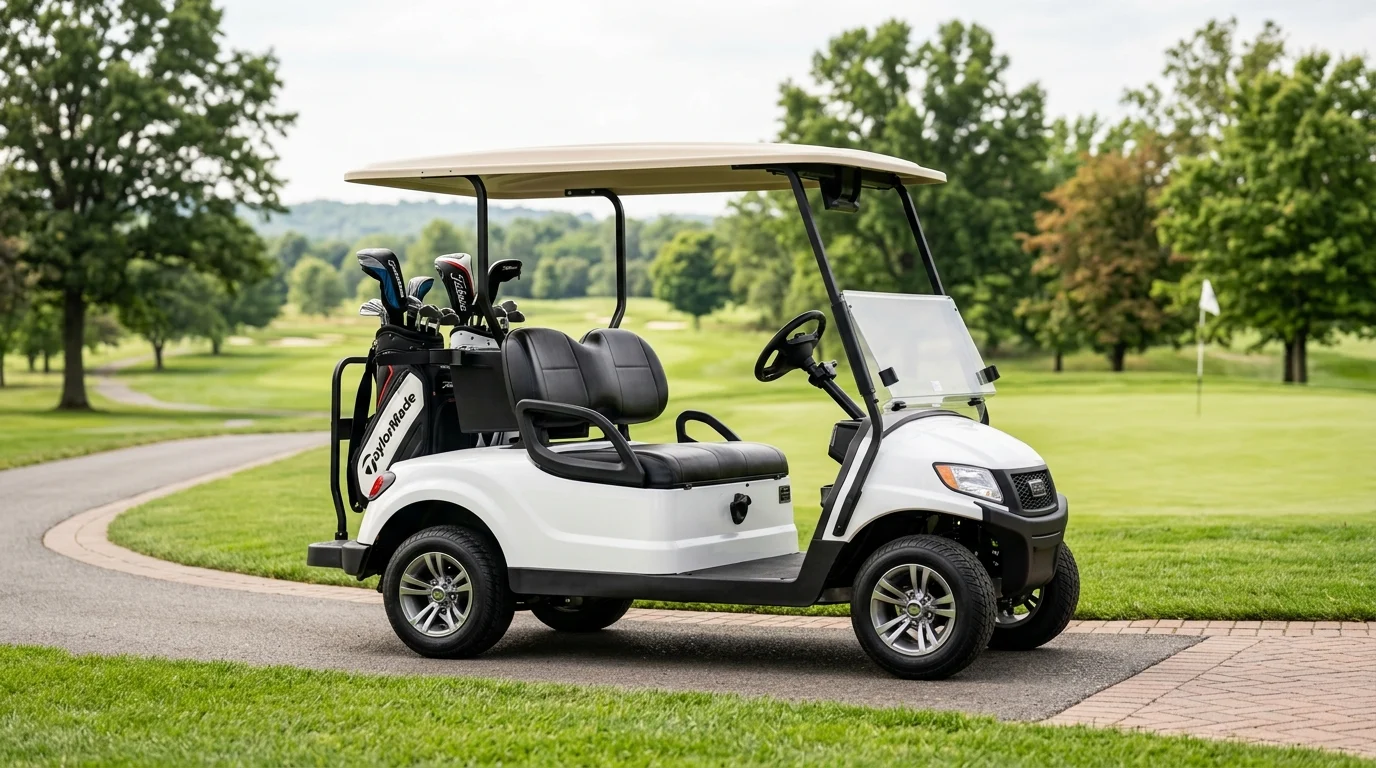
Operational Value of a 4-Seater Semi-Automatic Golf Cart
The modern 4-seater golf cart has evolved into a highly capable electric vehicle engineered for both leisure and light commercial applications. Sold as a specific “Full Set” package, this configuration arrives with six 12V 100AH batteries, a 3.0 kW to 5.0 kW AC motor, front and rear baskets, a cargo box, and a rain curtain bundled as standard inclusions. Although titled “semi-automatic,” this vehicle utilizes a fully automatic, single-speed direct-drive electric system. The “semi-automatic” label is often a regional marketing translation or legacy naming convention used to highlight the straightforward forward-neutral-reverse (F-N-R) switch operation rather than a manual gearbox.
While marketed as “ready to drive” upon delivery, this applies strictly to closed-course or private facility use. If the vehicle will cross or travel on public roads, buyers must ensure local municipal compliance for low-speed vehicles (LSVs). This often requires additional equipment like licensing, registration, DOT-approved (AS1/AS4) windshields, and specific mechanical braking systems capable of stopping within 6 meters at 32 km/h. By integrating passenger comfort with rugged cargo capacity, this off-road configuration eliminates the need to purchase separate carts for personnel transport and material handling, providing immediate utility for site supervisors and procurement professionals.
Key Use Cases for Multi-Purpose Transport
This 4-seater configuration excels in commercial environments requiring frequent, short-distance group transport (typically 15 to 25 km per day). In resort settings, campus tours, large industrial parks, and gated communities, the forward-facing four-seat layout accommodates small groups safely, supporting a typical total vehicle payload capacity of 350 to 450 kg. Equipped with comfortable bench or bucket seating and standard seat belts, the vehicle provides significantly more capacity than standard two-seater models without the unwieldy footprint of a six- or eight-passenger shuttle.
When deployed on the fairway, standard golf bag holders can be utilized, while the open design remains perfect for tourist excursions. Facility managers typically find this specific Full Set highly effective across mixed-use properties, as it can seamlessly serve groundskeeping crews in the morning and transport guests in the afternoon.
How Semi-Automatic Operation Improves Efficiency
The intuitive F-N-R control scheme is particularly advantageous for commercial fleets with multiple drivers and high staff turnover rates, significantly reducing operator training time to under 30 minutes. Drivers simply select the desired direction and press the accelerator pedal.
Furthermore, the smooth, gearless operation reduces driver fatigue during standard 8-hour shifts. Operating without the shifting jolts associated with traditional gas-powered gearboxes ensures a consistent, comfortable ride for passengers. This predictable acceleration curve—typically capped at a safe top speed of 25 to 40 km/h (15 to 25 mph)—improves overall safety and route efficiency across large campuses or sprawling park grounds.
Core Specifications for Range, Storage, and Hauling
Evaluating the technical specifications of this fully equipped Full Set ensures it meets the daily demands of both passenger transit and material transport. The following sections detail the typical performance metrics of the 72V 100AH battery system, the volumetric capacity of the included cargo box and baskets, and how the standard weather enclosures enable year-round operation. By understanding these core specifications, procurement teams can accurately project daily duty cycles, total cost of ownership, and maintenance requirements.
Battery Capacity and Expected Range
The primary power architecture of this Full Set relies on a robust 72V system. The standard configuration uses six 12V 100AH lead-acid batteries wired in series, charged via an included onboard smart charger. This setup yields an operational range of 50 to 60 kilometers per single charge, a metric highly dependent on terrain gradients, ambient temperature, and total payload weight.
Standard units utilize deep-cycle lead-acid batteries, which require a 6 to 8-hour charging window to reach full capacity and generally offer a lifecycle of 2 to 4 years (approximately 300 to 500 charge cycles). Site supervisors must account for routine maintenance with these standard batteries, including regular watering, terminal corrosion checks, and scheduled service intervals to maintain an optimal total cost of ownership.
For facilities requiring nearly continuous operation, upgrading to a single 72V 100AH lithium-ion battery pack can reduce charging times significantly (down to 3 to 5 hours) and eliminate watering maintenance. Lithium-ion systems also extend the range to 70–85 kilometers due to their significantly lower physical curb weight (often reducing total vehicle weight by an estimated 100 kg, depending on the manufacturer) and their ability to tolerate deeper discharge cycles without damage. Furthermore, lithium options extend the overall battery lifecycle to 8 to 10+ years (over 2,000 charge cycles).
| Specification | Standard Lead-Acid (6x 12V) | Upgraded Lithium-Ion (1x 72V) |
|---|---|---|
| System Capacity | 72V 100AH | 72V 100AH |
| Expected Range | 50–60 km | 70–85 km |
| Typical Charge Time | 6–8 hours | 3–5 hours |
| Estimated Lifecycle | 2–4 years (300–500 cycles) | 8–10+ years (2,000+ cycles) |
| Maintenance | High (Watering/Cleaning) | Zero-Maintenance |
| Weight Impact | Baseline | ~100 kg lighter |
Basket, Cargo Box, and Load Capacity
Storage utility is maximized through the standard inclusion of both front and rear built-in baskets, alongside a dedicated rear cargo box. The mesh or solid-designed baskets facilitate easy access for personal items or groundskeeping tools, adding practical utility beyond simple passenger transport. Simultaneously, the larger rear cargo box (typically measuring around 800mm x 1100mm x 250mm) handles heavier maintenance supplies, facility deliveries, and equipment hauling, supporting dedicated cargo payloads of 100 to 150 kg. Many premium models feature fold-down sides on the cargo box for easier side-loading of bulky materials.
To protect both passengers and cargo during seasonal operation, the included clear vinyl rain curtain (usually 0.5mm to 0.8mm thickness) attaches directly to the roof frame. Featuring zippered doors for rapid entry and a roll-up design for sunny days, the enclosure shields occupants and sensitive cargo from wind, rain, and cold weather.
How Buyers Should Choose the Right 4-Seater Golf Cart
Comparing Capacity, Features, and Terrain Needs
Selecting the optimal golf cart requires evaluating the specific application environment. A dual-purpose 4-seater layout balances passenger capacity with maneuverability, making it highly effective for resorts, campuses, and sightseeing tours. Buyers must assess terrain and daily range requirements before procurement. A 72V power system utilizing six 100AH batteries typically delivers a 50 to 80-kilometer range per charge, accommodating extended shifts without requiring mid-day downtime.
Terrain and driver experience also dictate drivetrain selection. A semi-automatic transmission eliminates the clutch pedal and manual shifting. By simply selecting forward or reverse, this system reduces driver fatigue and simplifies fleet operations, particularly when multiple personnel share the same vehicle. Finally, operational utility depends heavily on storage capacity. Models equipped with a dedicated rear cargo box and dual front/rear baskets allow operators to haul maintenance supplies, tools, or guest luggage simultaneously, maximizing the vehicle’s return on investment.
Final Buying Checklist
Before finalizing a purchase, fleet managers and individual buyers should verify that the golf cart meets all environmental and operational demands. Use this technical checklist to ensure a comprehensive evaluation:
- Drivetrain Specifications: Confirm the inclusion of a semi-automatic transmission to ensure smooth operation across all driver skill levels.
- Power and Range: Verify the battery configuration (e.g., 6 pieces of 100AH batteries yielding 72V) supports the necessary daily mileage and fits within a standard 6 to 8-hour charging window.
- Utility and Storage: Check for built-in cargo solutions, including easy-access front/rear baskets and a robust cargo box for commercial hauling tasks.
- Weather Readiness: Ensure the vehicle features a clear vinyl rain curtain with zippered doors. This protects passengers from wind and rain, extending the usable weather range of the sightseeing vehicle for year-round operation.
- Turnkey Delivery: Prioritize “ready to drive” full-set packages that include safety seat belts and all structural accessories to minimize aftermarket modifications and deployment delays.
Key Takeaways
- Use this 4-seater configuration for mixed passenger and light cargo duties where daily travel is typically around 15 to 25 km on private property.
- Confirm local low-speed vehicle rules before using the cart on public roads, because licensing, approved glass, lighting, and braking requirements may apply.
- The included six 12V 100AH batteries, baskets, cargo box, and rain curtain reduce the need for immediate aftermarket upgrades.
- Train new operators quickly by using the simple forward-neutral-reverse electric drive system, which can reduce onboarding time to under 30 minutes.
- Match the cart to realistic load requirements, as typical total payload capacity falls around 350 to 450 kg depending on configuration and conditions.
Frequently Asked Questions
Is this 4-seater golf cart truly ready to drive on delivery?
It is ready for use on private property, closed courses, resorts, campuses, and similar facilities. Public-road use may require local low-speed vehicle compliance, registration, lighting, approved windshield, braking standards, and other legal equipment.
What does the full set package include?
The package includes six 12V 100AH batteries, front and rear baskets, a cargo box, and a rain curtain, making it suitable for both passenger transport and light-duty hauling.
What does semi-automatic mean for this electric golf cart?
In this context, semi-automatic generally refers to simple forward-neutral-reverse operation. The cart uses a single-speed electric drive system, so drivers do not manually shift gears.
How many passengers can the vehicle carry?
The vehicle is designed for four passengers in a forward-facing layout. Its typical total payload capacity is about 350 to 450 kg, depending on configuration and operating conditions.
What are the best use cases for this golf cart?
It is well suited for golf courses, resorts, gated communities, campuses, industrial parks, sightseeing routes, and facilities that need short-distance staff, guest, or light cargo transport.
Post time: Aug-04-2026